About FootNet
FootNet is a state-of-the-art deep learning emulator designed to replicate atmospheric transport processes that relate greenhouse gas (GHG) emissions at the surface to their atmospheric observations. Built on a U-Net++ architecture, FootNet learns the complex, physics-informed relationships between meteorology and atmospheric motion, allowing it to generate source-receptor relationships or “footprints” at kilometer-scale resolution. The model operates over 650 times faster than traditional full-physics Lagrangian models like STILT and X-STILT, enabling rapid, scalable simulations of GHG transport across the contiguous United States. By reducing computational demands while preserving scientific accuracy, FootNet makes high-resolution flux inversion frameworks more accessible and efficient for both research and operational applications.
Vision
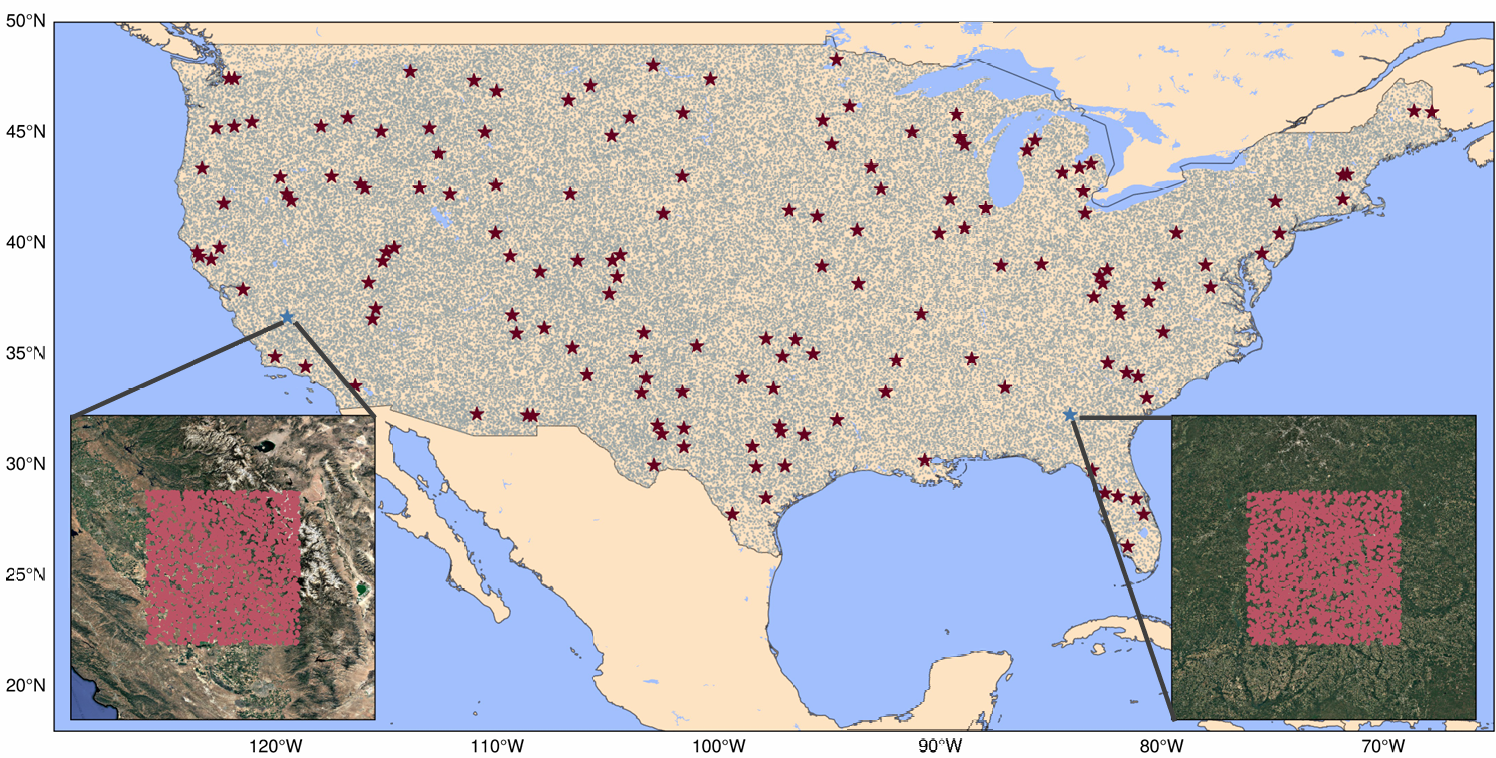
FootNet was created to make atmospheric transport modeling faster, easier, and scalable for anyone studying greenhouse gas emissions. It has been trained on over 500,000 examples across the United States, allowing it to work accurately even in new regions and weather conditions it hasn’t seen before. Whether you are estimating methane emissions from an oil and gas basin or studying urban CO₂ trends, FootNet helps you generate footprints in seconds instead of hours. Our goal is to help researchers, students, and policymakers use state-of-the-art transport modeling without needing large computing resources — empowering more people to use data-driven approaches to understand and reduce greenhouse gas emissions.
Contact
For questions about the project or collaboration inquiries, please email turneraj@uw.edu or nd349@uw.edu.