FootNet: machine learning emulator of atmospheric transport
FootNet is a deep learning emulator of atmospheric transport based on a U-Net++ architecture. It generates source-receptor relationships (footprints) for both surface and column-averaged measurements at a kilometer resolution, operating hundreds of times faster than traditional Lagrangian models. FootNet consists of two separate models, one for surface measurements and one for the column-averaged measurements. It is trained on 500,000 pseudo-observations across the continuous United States using meteorological data from HRRR.
Main features
- Generalization
- Trained on diverse meteorology and locations, enabling accurate predictions even in regions withheld during training.
- Supports both flat and complex terrain.
- Footprints for Surface Measurements
- Computes footprints for in-situ and dense surface measurements.
- E.g. BEACO2N, INFLUX etc.
- Footprints for Column-averaged Measurements
- Computes footprints for column-averaged measurements.
- E.g. TROPOMI, OCO-2/3 etc.
- Computational and Storage Efficiency
- Computes footprints in less than a second on a single GPU, achieving a ~650× speedup compared to full-physics models such as STILT.
- No need to store footprints; compute them on-the-fly
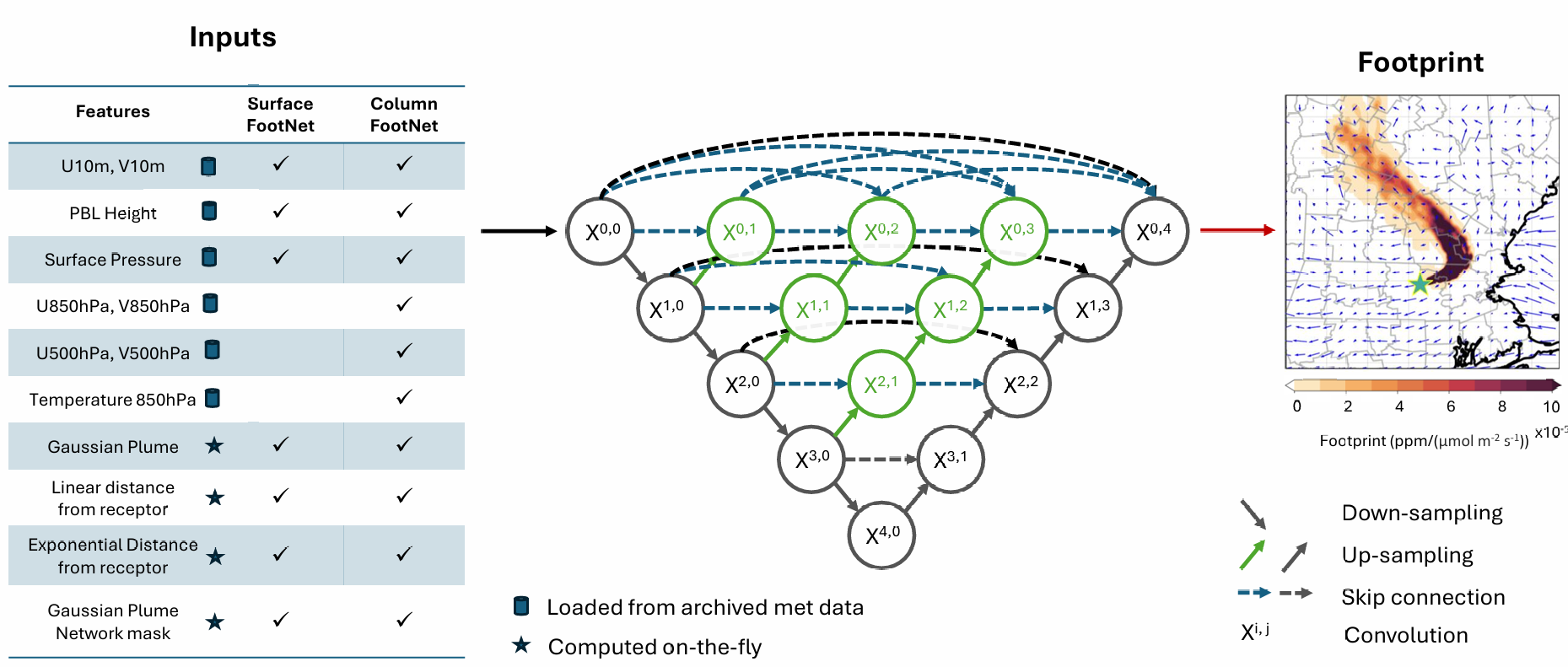
How FootNet works
1. Define the receptor(s)
A receptor is defined by its location, time, and the measurement type (surface or column-averaged). Identifying these receptors allows us to determine the source-receptor relationships (footprints).
2. Input data for receptors
Gather required meteorological data for the specified receptors up to 24 hours before the measurement was made. FootNet uses meteorological fields such as U and V components of winds, boundary layer height, temperature, and surface pressure etc. to compute footprints. FootNet also requires other inputs such as Gaussian plume, plume mask, distance of each pixel in the domain from the receptor. These inputs are computed on the fly by the FootNet package using the meteorological data. Figure above shows the input channels required for surface and column-averaged measurements.
3. Generate footprints
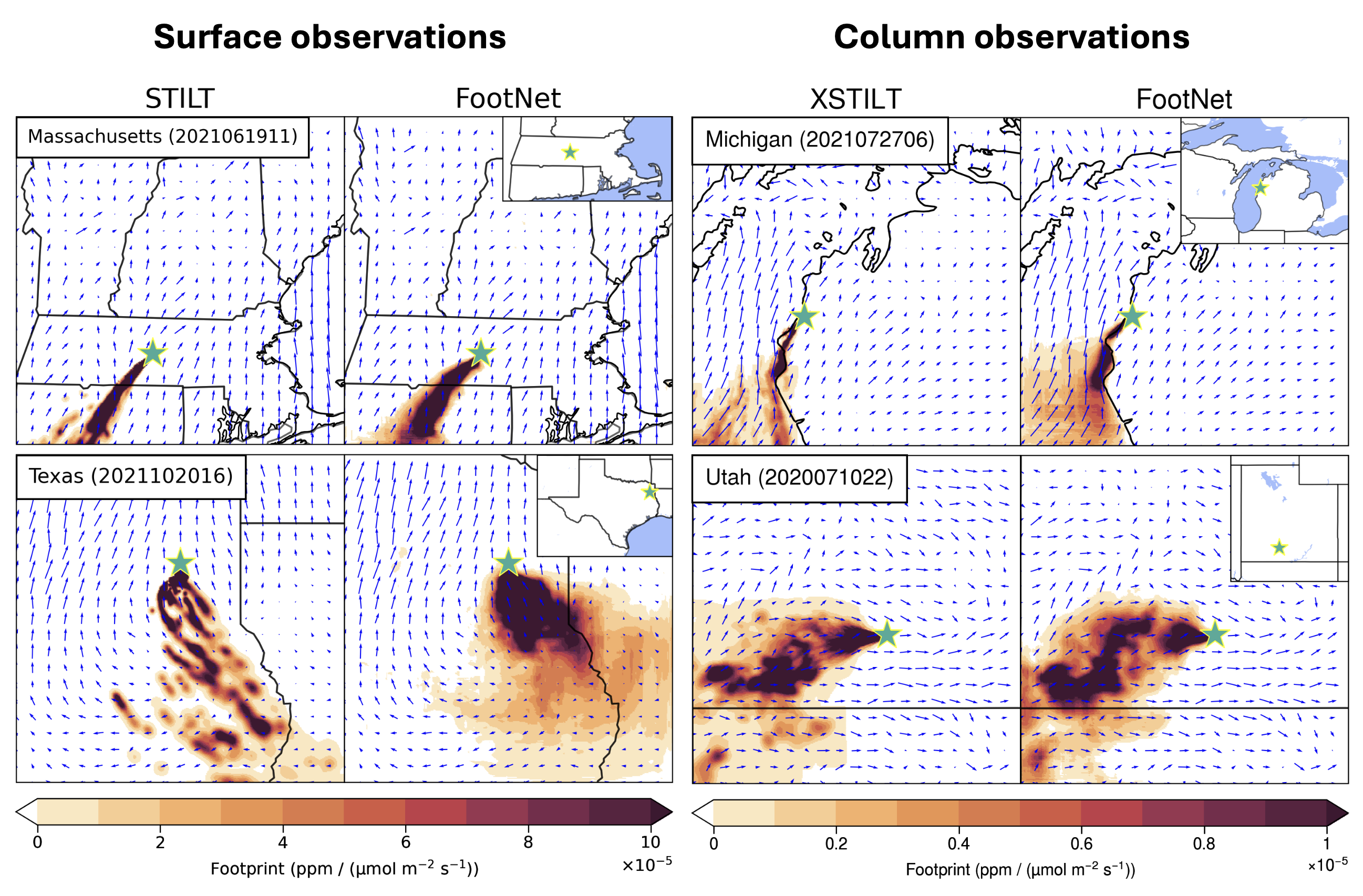
FootNet utilizes the provided meteorological and auxiliary data to generate high-resolution footprints for the specified receptors. The model processes the inputs through its deep learning architecture to produce accurate source-receptor relationships. These relationships can be stored in NetCDF format or can also be used on-the-fly in flux inversions.
4. Using FootNet footprints in flux inversions
Footprints generated by the FootNet can be directly used in atmospheric inversions to estimate surface fluxes for greenhouse gases such as CO2 and methane. The footprints can be integrated with various inversion frameworks to derive flux estimates from measurement data.
Next steps
Dive straight into the model documentation or start with a quick example.